
E-flat minor
E-flat minor guitar chord is also written as E♭min or E♭m.
Below are up to 8 popular shapes for the E-flat minor guitar chord, with suggested finger positions on the fretboard.
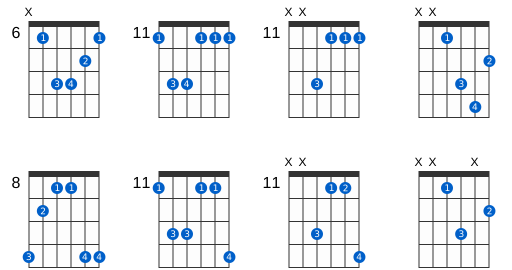
How to play the E-flat minor chord
String numbers run from the thinnest string (1st) to the thickest string (6th). Match each numbered finger to the diagrams.
Shape x68876
- Place your index finger (1) on the 6th fret of the 1st (high E) string and 5th (A) string in a barre.
- Place your middle finger (2) on the 7th fret of the 2nd (B) string.
- Place your ring finger (3) on the 8th fret of the 4th (D) string.
- Place your little finger (4) on the 8th fret of the 3rd (G) string.
- Do not play the 6th (low E) string.
Shape 111313111111
- Place your index finger (1) on the 11th fret of the 1st (high E) string, 2nd (B) string, 3rd (G) string, and 6th (low E) string in a barre.
- Place your ring finger (3) on the 13th fret of the 5th (A) string.
- Place your little finger (4) on the 13th fret of the 4th (D) string.
E-flat minor chord guide
E-flat minor is a three-note minor triad built from E♭, G♭, and B♭. It is useful both as a full rhythm chord and as a smaller voicing that leaves room for vocals or another guitar. Learn the shapes above, then listen for the three chord tones inside each one rather than treating the diagram as a collection of unrelated dots.
E-flat minor notes and fretboard landmarks
The formula for E-flat minor is 1-♭3-5: E♭ is the root, G♭ is the minor third, and B♭ is the perfect fifth. The third is the note that makes this chord sound minor; changing it by one fret changes the chord quality. The same three notes may appear more than once in a guitar shape, in different octaves.
To orient yourself away from a chart, find E♭ at the 6th fret of the A string and the 11th fret of the low E string. From a root, the other chord tones can be heard and located as the third and fifth. That small piece of fretboard awareness makes it easier to recognise a E-flat minor voicing even when it does not look like the first shape you learned.
Choose a voicing that serves the part
Start with the most comfortable clean shape shown above, but do not assume every diagram should be strummed across all six strings. Follow its open- and muted-string markings, pick through the intended strings once, then decide how much of the voicing the arrangement needs. A compact shape on the higher strings often sits better under a singer or beside a second guitarist than a large, low-register grip.
When changing chords, preserve any finger that can stay in place and move the others as a group. If a full grip is slowing a song down, practice the smallest version of the shape first - root, third, and fifth are enough to establish the harmony. Add doubled notes only after the basic change is reliable. Use a one-minute clean-note check. Pick through the diagrammed strings slowly, correct the first muted or buzzing note, then strum a steady rhythm. This separates left-hand accuracy from right-hand timing and gives practice a clear target.
Use E-flat minor musically
When E-flat minor is the home chord, hear it as i and try moving from i to iv before returning home. Minor-key songs often use a major V or a flattened-VII chord for contrast, so let the melody and bass decide how much tension the progression needs. Arpeggiating E♭, G♭, and B♭ is a direct way to hear the chord's darker colour without changing the harmony.
For rhythm practice, keep the fretting hand stable while changing the right hand: try even downstrokes, then a down-up pattern, then a bass note followed by lighter treble strings. The chord should remain identifiable at each dynamic level. That control is more musical than simply playing the same shape louder.
E-flat minor chord FAQ
What notes are in E-flat minor?
E-flat minor contains E♭, G♭, and B♭. These are the root, the minor third, and the perfect fifth; guitar shapes often repeat one or more of them in another octave.
What makes E-flat minor minor?
Its third determines the quality. E-flat minor uses G♭, which sits three semitones above E♭; moving that note by one semitone changes a minor triad into a major triad.
Do I need to strum every string in E-flat minor?
No. Use the open and muted string markings on the specific diagram. Some voicings use all six strings, while partial shapes deliberately use only the strings that make the chord clear and fit the accompaniment.
Why does my E-flat minor chord buzz or sound unclear?
Check one string at a time. Place each fingertip just behind its fret, keep it arched so it does not touch a neighbouring string, and use only enough pressure for a clean note. Slow, separate-string checks reveal the problem quickly.
Can I play E-flat minor in other positions?
Yes. The notes E♭, G♭, and B♭ repeat across the neck, so the same harmony can be voiced as an open chord, a barre shape, or a smaller three- or four-string grip. Choose the position that supports the melody and the other instruments.
View E-flat minor inversions and slash chords
View minor chord for guitar with other root notes
C - D - E - F - G - A - B - C♯ - D♯ - F♯ - G♯ - A♯ - D♭ - E♭ - G♭ - A♭ - B♭