
G major
G major guitar chord is also written as Gmaj or G or GM.
Below are up to 8 popular shapes for the G major guitar chord, with suggested finger positions on the fretboard.
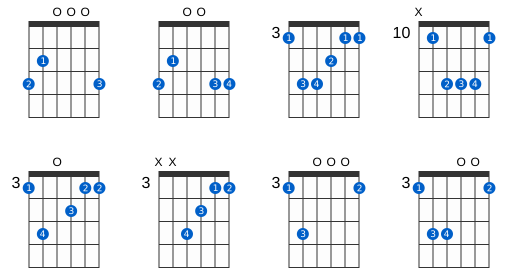
How to play the G major chord
String numbers run from the thinnest string (1st) to the thickest string (6th). Match each numbered finger to the diagrams.
Shape 320003
- Place your index finger (1) on the 2nd fret of the 5th (A) string.
- Place your middle finger (2) on the 3rd fret of the 6th (low E) string.
- Place your ring finger (3) on the 3rd fret of the 1st (high E) string.
- Let the 2nd (B) string, 3rd (G) string, and 4th (D) string ring open.
Shape 320033
- Place your index finger (1) on the 2nd fret of the 5th (A) string.
- Place your middle finger (2) on the 3rd fret of the 6th (low E) string.
- Place your ring finger (3) on the 3rd fret of the 2nd (B) string.
- Place your little finger (4) on the 3rd fret of the 1st (high E) string.
- Let the 3rd (G) string and 4th (D) string ring open.
G major chord guide
G major is one of the first open chords worth making dependable. Its full, ringing sound works in folk, rock, country, pop, and blues, and it sits naturally beside C, D, and E minor. The open-position shape uses all six strings, so a clean G is as much about relaxed hand position and accurate strumming as it is about putting fingers in the right frets.
G major notes and the open shape
A G major chord contains G, B, and D: the root, major third, and perfect fifth. In the common open voicing, written 320003 from the sixth string to the first, the low E string is fretted at the 3rd fret for G, the A string at the 2nd fret for B, and the D, G, and B strings ring open. Fret the high E string at the 3rd fret for another G. That repeated root at both ends is part of why the shape sounds so broad on an acoustic guitar.
For the fingering shown here, use your middle finger on the low E string, index finger on the A string, and ring finger on the high E string. Keep each fingertip close behind its fret, without resting on the fret wire. Let the fingers curl enough that the open D, G, and B strings have room to ring. Pick the strings one at a time before strumming; it is much faster to find one muted note than to diagnose a cloudy full chord.
- Strum all six strings for the standard open G; the low sixth string is the chord's root, not a string to mute.
- If the open B or high E string buzzes, move the fretting fingertip nearer to the fret and check that its knuckle is arched.
Choose the G shape that suits the song
The 320003 fingering is the practical starting point because it uses three fingers and leaves three strings open. Many players also use 320033, fretting the B and high E strings at the 3rd fret with ring and pinky. It is still a G major chord, but its doubled D and G make the top of the chord fuller. That four-finger version also keeps the ring and pinky ready for familiar changes to Cadd9 and Dsus4, which can make a progression feel smoother.
Open G is not the only useful voicing. Higher on the neck, movable major shapes let you place G where it supports a melody or avoids competing with another guitarist. Start with the open form for rhythm, then learn a barre or partial-chord version when you need a tighter sound. The important test is musical: choose the voicing whose lowest note, brightness, and sustain fit the arrangement rather than assuming the largest grip is always best.
Build clean changes and useful progressions
Practice G as a change, not as a held pose. Form the chord, strum once, release your hand completely, and rebuild it. Then alternate with C and D at a pace where every note still rings. On a metronome, give yourself four beats per chord before reducing to two beats, then one. Slow, accurate repetitions teach the fingers a reliable path; rushing usually teaches them to land in a different place each time.
In the key of G, G major is the I chord. The essential I-IV-V movement is G-C-D, and G-Em-C-D is a widely useful four-chord loop. Listen for the pull from D back to G: D contains F♯, which leads naturally to G. Once those changes feel settled, try controlling dynamics instead of changing the chord - light downstrokes in a verse, then broader strums or a bass-note-first pattern in a chorus.
For fingerstyle, let the low G establish the pulse while the open middle strings provide the harmony. A simple approach is to alternate the sixth and fourth strings with the thumb, then add the open G, B, and high E strings with the fingers. Keep the bass notes even before adding a more complicated pattern. This makes the chord useful beyond basic strumming and helps you hear how its individual notes work together.
G major chord FAQ
What are the notes in a G major guitar chord?
G major is built from G, B, and D. G is the root, B is the major third that gives the chord its major quality, and D is the fifth. Guitar voicings repeat some of those notes in different octaves.
Which open G fingering should a beginner learn first?
Start with 320003: middle finger on the 3rd fret of the low E string, index finger on the 2nd fret of the A string, and ring finger on the 3rd fret of the high E string. It is a complete G major chord and a good foundation for other open-chord changes.
Should all six strings ring in open G major?
Yes. For the usual 320003 or 320033 open shapes, strum from the sixth string through the first string. The low E string, fretted at the 3rd fret, supplies a low G root.
Why does my G chord sound muffled or buzzy?
Usually a fretting finger is touching an open string or is too far from the fret. Test each string separately, curl the fingers onto their tips, and place them just behind the fret with only enough pressure to make a clean note. A relaxed thumb behind the neck helps the fingers stay arched.
How is G major different from G7?
G major contains G, B, and D. G7 adds F natural, a flattened seventh, which creates more tension and often wants to resolve to C. Use plain G major when the song calls for a stable major tonic sound.
View G major inversions and slash chords
View major chord for guitar with other root notes
C - D - E - F - G - A - B - C♯ - D♯ - F♯ - G♯ - A♯ - D♭ - E♭ - G♭ - A♭ - B♭